


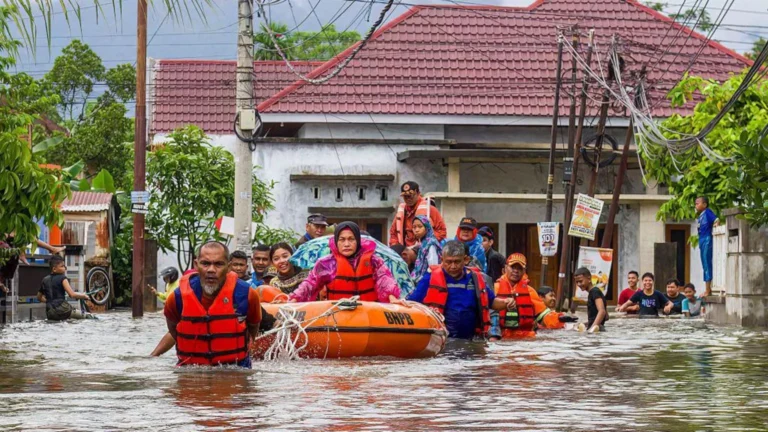
Heavy downpours have led to flooding and landslides in various regions of southern Asia, claiming the lives of around 600 individuals.
The monsoon rains, intensified by tropical storms, have caused some of the worst flooding the area has seen in years, impacting millions in Indonesia, Malaysia, Thailand, and Sri Lanka.
The deluge began on the Indonesian island of Sumatra on Wednesday. A local resident from Bireuen in Aceh province recounted, “When the floods came, all was lost. I attempted to save my clothes, but my house collapsed.”
With hundreds still unaccounted for, the number of casualties is expected to increase. Many individuals remain trapped, with some waiting for rescue on rooftops.
As of Saturday, fatalities included over 300 in Indonesia and 160 in Thailand, with additional deaths reported in Malaysia.
In Sri Lanka, which has suffered greatly from Cyclone Ditwah, officials confirmed over 130 deaths and approximately 170 people missing.
A notably rare tropical cyclone, designated as Cyclone Senyar, triggered disastrous landslides and severe flooding in Indonesia, sweeping away homes and submerging thousands of structures.
According to Indonesia’s disaster management agency, nearly 300 individuals are still missing following the devastating floods in Sumatra.
“The current was incredibly swift; it reached the streets and entered the houses in a matter of seconds,”
“The current was incredibly swift; it reached the streets and entered the houses in a matter of seconds,”
She and her grandmother hurried to a relative’s residence situated on higher ground. When they returned the next day to collect their possessions, she remarked that the flood had entirely engulfed their house: “It’s already submerged.”
After water levels rapidly rose in West Sumatra, Meri Osman described being “carried away by the current” and holding onto a clothesline until rescuers arrived.
Adverse weather conditions have complicated rescue efforts, and while thousands have been evacuated, numerous individuals are still stranded, as reported by the disaster agency.
In Thailand’s southern Songkhla province, water surged to 3 meters (10 feet), resulting in at least 145 deaths in one of the most significant floods in a decade.
The government reported that across the ten affected provinces, over 160 people have died, with more than 3.8 million individuals impacted.
The city of Hat Yai recorded an unprecedented 335mm of rainfall in a single day, the highest in 300 years. As water levels receded, officials noted a worrying increase in the number of fatalities.
At a hospital in Hat Yai, staff had to relocate bodies to refrigerated trucks due to the morgue being overwhelmed.
“We were stranded in the water for seven days with no assistance from any agency,”
“We were stranded in the water for seven days with no assistance from any agency,”
The government has pledged to provide relief, including compensation of up to two million baht ($62,000) for families that have lost loved ones.
In nearby Malaysia, although the death toll is relatively lower, the devastation is still severe.
Flooding has caused significant disruption, leaving portions of northern Perlis state submerged, with two fatalities and tens of thousands in temporary shelters.
Sri Lanka is battling one of its worst weather-related crises in recent years, prompting the government to declare a state of emergency.
Officials noted that more than 15,000 homes have been destroyed, with around 78,000 individuals necessitating temporary shelters. Additionally, roughly one-third of the nation is without electricity or running water.
Meteorologists suggest that the extreme weather patterns in Southeast Asia may be attributed to the interaction of Typhoon Koto in the Philippines and the unusual formation of Cyclone Senyar in the Malacca Strait.
The region typically experiences its monsoon season from June to September, when heavy rain is common.
Climate change has significantly modified storm patterns, including the potency and length of the season, leading to more intense rainfall, flash flooding, and stronger winds.


Comments